Nivel A1 · Guía de Repaso y Trabajo IntegralLevel A1 · Comprehensive Foundation Review
Spanish A1 Foundation: Review & Practice Guide
Los 4 Pilares: Interacción Social, Lógica de Género, Existencia con HAY y AdjetivosThe 4 Pillars: Social Interaction, Noun Logic, HAY Existence & Adjectives
Pasa de memorizar palabras a comprender los patrones del español con explicaciones claras y ejercicios prácticos.Move from memorizing words to understanding Spanish patterns with clear rules and targeted exercises.
Estudiante:Student:
Fecha:Date:
1. Introduction & Welcome
¡Bienvenido! Welcome to your Spanish A1 Foundation workbook. This guide moves you away from simple memorization toward understanding patterns so you can speak with confidence.
We have structured this master review around the 4 Pillars of Foundational Spanish:
1. Social Interaction: Greetings, introductions, and street reactions.
2. Noun Logic: Grammatical gender rules, Greek traps, and cognate markers.
3. Existence: Mastering the magic word HAY.
4. Description: Adjective rules, agreement grids, and rich descriptions.
1Sección 1: Saludos, Despedidas y Expresiones de la CalleSection 1: Greetings, Farewells & Street Expressions
A. The Social Spectrum — Formality matters in Spanish culture.
Spanish Phrase
English Meaning
Context / Usage Note
Hola
Hello / Hi
Basic greeting, used any time.
Buenos días
Good morning
Used until around noon.
Buenas tardes
Good afternoon
Used from noon until sunset.
Buenas noches
Good evening / Good night
Used after sunset.
Buenas
"Hey" / "Hi"
The Universal Shortcut: Works 24/7. Friendly & relaxed.
B. Checking In & Introducing Yourself
• Formal: ¿Cómo está usted?
• Informal: ¿Cómo estás? / ¿Cómo te va?
• Casual: ¿Qué tal? / ¿Qué hay? / ¿Todo bien?
• Responses: Muy bien, gracias | Todo bien | Más o menos | Aquí, tirando.
• Introductions: Me llamo... / Soy... | Mucho gusto | Encantado / Encantada.
C. Saying Goodbye & D. Street Tools
• Farewells: Adiós | Hasta luego | Hasta mañana | Chao | Nos vemos | Hablamos.
• Street Reactions: ¡Qué bien! / ¡Qué bueno! | ¡Qué pena! / ¡Qué lástima! | ¡No me digas! | ¡En serio? | ¡Claro! / ¡Por supuesto!
• Survival Phrases: Con permiso | ¿Cómo se dice...? | Más despacio, por favor | No entiendo.
Section 1 Practice — I. Situational Prompts:
1. You walk into a shop at 10:00 AM. Greet the clerk:
2. You need to get past a crowd on a bus. What do you say?
3. Leaving a friend's house, seeing them tomorrow:
4. You meet a new person and say "Nice to meet you":
5. Your teacher is speaking too fast. What do you ask?
Section 1 Practice — II. Street Reaction Matching:
1. A friend tells you they lost their phone. ➔
2. A friend tells you they got a promotion. ➔
3. Someone tells you a shocking secret. ➔
Tucaneo Academy
Español con Alas Propias · Level A1
2Sección 2: El Género de los SustantivosSection 2: Noun Gender in Spanish
• Basic Pattern: Masculine -o (el gato, el libro) | Feminine -a (la casa, la mesa).
• Greek Trap:-ma, -pa, -ta are masculine (el problema, el mapa, el planeta, el tema, el sistema, el idioma, el programa).
• Feminine Markers:-ción / -sión (la canción) | -dad / -tad (la ciudad) | -tud (la actitud).
• Short-Form Exceptions:la foto (fotografía), la moto (motocicleta), la radio (radiodifusión), la mano.
• Advanced:-or (el color) & -aje (el viaje) are masculine. -ista / -nte are invariable (el/la estudiante).
Section 2 Practice — I. Identify Gender & Rule: Select EL or LA for each noun.
1. conversación (Rule: -ción)
2. programa (Rule: Greek -ma trap)
3. libertad (Rule: -dad)
4. moto (Rule: Short form motocicleta)
5. viaje (Rule: -aje ending)
Section 2 Practice — II. Spot the Error: Correct the mistake.
1. La problema es muy difícil. ➔
2. El ciudad de Bogotá es bonita. ➔
3. Tengo la mapa en mi teléfono. ➔
3Sección 3: La Palabra "HAY"Section 3: The Magic Word "HAY"
HAY (there is / there are) expresses general existence.
• DO use with: Indefinite articles (un, una, unos, unas), numbers (dos, tres), quantity words (mucho, poco), zero article.
• DON'T use with: Definite articles (el, la, los, las). Never say "Hay el libro".
Section 3 Practice — Fill in & Translation:
1. En el refrigerador, mucha leche.
2. Is there a pharmacy? ➔
3. There are three options. ➔
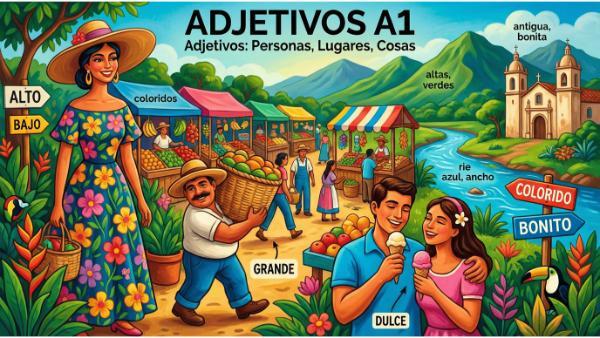
4Sección 4: Los AdjetivosSection 4: Adjectives in Spanish
• Placement: AFTER the noun (una casa grande).
• Agreement: Match gender & number (alto / alta / altos / altas).
• Mixed Groups: Always use masculine plural (Ana y Pedro son simpáticos).
Section 4 Practice — Multiple Choice & Description:
1. Mi hermana es muy .
2. Las calles son muy .
3. Los profesores son muy .
Describe a Person: Write 2 sentences about a friend/family member (Name: ):
1.
2.
Section 1 Solutions: 1. Buenos días | 2. Con permiso | 3. Hasta mañana | 4. Mucho gusto / Encantado(a) | 5. Más despacio, por favor. Matching: 1-C (¡Qué pena!), 2-A (¡Qué bien!), 3-B (¡No me digas!). Section 2 Solutions: 1. La | 2. El | 3. La | 4. La | 5. El. Errors: 1. El problema | 2. La ciudad | 3. El mapa. Section 3 Solutions: 1. hay | 2. ¿Hay una farmacia? | 3. Hay tres opciones. Section 4 Solutions: 1. simpática | 2. limpias | 3. amables.
Ready to speak Spanish with confidence?
Book a free trial class with Camilo and start your journey today.
Terminaste la hoja. ¿La practicamos hablando?You finished the worksheet. Shall we practice it out loud?
Soy Camilo, el que hizo este material. Doy clases uno a uno, en vivo, y te digo en dos minutos qué te conviene practicar después de esto.I'm Camilo, the teacher who made this material. I teach one-to-one, live, and in two minutes I can tell you what to practice next.

 Adjetivos Esenciales A1Grammar Guide
 La Palabra Mágica: HAYGrammar Guide
 Examen 1: Fundamentos A1A1 Exam