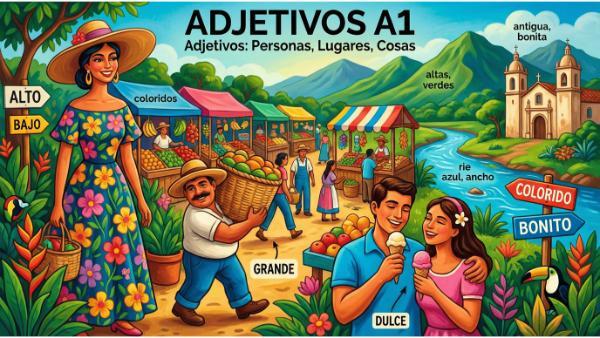
Nivel A1 · Describiendo Personas y Objetos
Level A1 · Describing People & Objects
Essential Spanish Adjectives (A1)
Los Adjetivos en Español: Posición, Género y Número
Spanish Adjectives: Position, Gender & Number Agreement
Aprende las 3 reglas de oro para describir personas, lugares y cosas en español con ejemplos y ejercicios claros.
Learn the 3 golden rules to describe people, places, and things in Spanish with clear rules and practice.
1
Parte 1: ¿Qué es un adjetivo?
Part 1: What is an adjective?
Un adjetivo es una palabra que describe a un sustantivo (persona, lugar o cosa). Indica cómo es algo: su tamaño, color, personalidad o calidad.
An adjective is a word that describes a noun (a person, a place, a thing, or an idea). It tells us what something is like: its size, color, personality, or quality.
• English: "a tall man", "a beautiful city"
• Spanish: "un hombre alto", "una ciudad hermosa"
2
Parte 2: Las 3 Reglas de Oro de los Adjetivos
Part 2: The 3 Golden Rules of Spanish Adjectives
RULE 1 — Position (Where does it go?)
In Spanish, adjectives go AFTER the noun. This is the opposite of English!
• English: A tall man (Adjective + Noun)
• Spanish: Un hombre alto (Noun + Adjective)
RULE 2 — Gender Agreement (Masculine & Feminine)
Adjectives must match the gender of the noun (masculine or feminine):
• Ends in -o: Change to -a for feminine words (El chico es alto / La chica es alta).
• Ends in -e or consonant: Stays the same for both genders (Él es inteligente / Ella es inteligente; El chico es joven / La chica es joven).
RULE 3 — Number Agreement (Singular & Plural)
Adjectives match whether the noun is singular (one) or plural (more than one):
• Ends in a vowel: Add -s (alto ➔ altos).
• Ends in a consonant: Add -es (joven ➔ jóvenes).
• Ends in -z: Change to -ces (feliz ➔ felices).
• Note for Mixed Groups: Groups of male & female take the masculine plural form (Ana y Pedro son simpáticos).
3
Parte 3: Banco de Vocabulario Esencial
Part 3: Essential Vocabulary Bank
1. Personality
- • simpático / -a (nice)
- • inteligente (intelligent)
- • trabajador / -ora (hardworking)
- • divertido / -a (fun/funny)
2. Appearance
- • alto / -a (tall)
- • bajo / -a (short)
- • guapo / -a (handsome/pretty)
- • delgado / -a (slim)
3. Things & Places
- • grande (big, large)
- • pequeño / -a (small)
- • bonito / -a (pretty, nice)
- • fácil (easy)

 Tropical Adjective ChallengeInteractive Deck
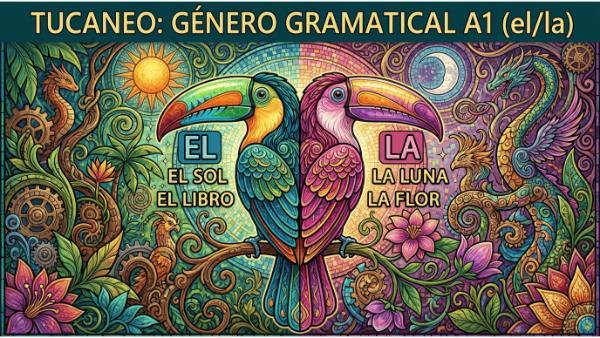 Género de los SustantivosGrammar Guide
 A Day in SpanishSurvival Game