Nivel A1 · El Género de los Sustantivos (El vs La)Level A1 · Noun Gender in Spanish (El vs La)
Study Guide: Noun Gender in Spanish
Reglas de Género, Excepciones Griegas y Conexiones con el InglésGender Rules, Greek Exceptions & English Cognate Patterns
Aprende la lógica detrás de los sustantivos masculinos y femeninos en español con explicaciones claras y ejercicios.Understand the logic behind masculine and feminine nouns in Spanish with clear rules and practice.
Estudiante:Student:
Fecha:Date:
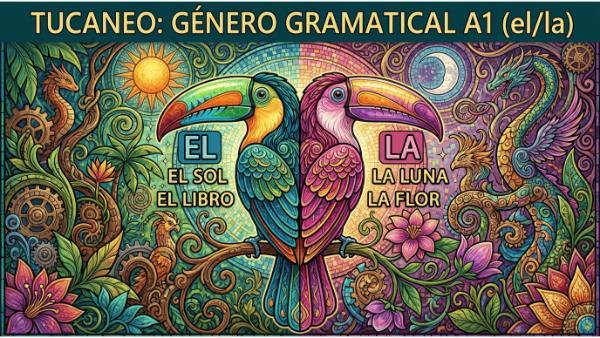
11. ¿Qué es el género gramatical?1. What is grammatical gender?
In Spanish, every noun (person, place, thing, or idea) has a gender: it is either masculine or feminine. This is purely grammatical and does not mean objects have biological gender!
• A table (la mesa) is feminine.
• A book (el libro) is masculine.
Why does it matter? Because articles ("the" = el / la) and any adjectives must match the noun's gender. Getting this right makes you sound natural from day one!
22. Regla 1: La Regla Básica (-o / -a)2. RULE 1: The Basic Rule (-o and -a)
Often, the ending of the word gives you a massive hint:
• Masculine (el): Words ending in -o are usually masculine (el gato, el libro, el niño).
• Feminine (la): Words ending in -a are usually feminine (la casa, la mesa, la ventana).
👉 Golden Strategy: Always learn a new noun together with its article. Don't just learn "casa"—always learn "la casa"!
Watch out! Some words end in -a but are masculine (they use el). Many Spanish words ending in -ma, -pa, or -ta come from ancient Greek and kept their original masculine gender:
• el problema (the problem)
• el mapa (the map)
• el plane**ta** (the planet)
• el siste**ma** (the system)
Many Spanish feminine endings relate directly to English word endings! Use these patterns to guess the gender correctly almost every time:
• -ción / -sión (English: -tion / -sion) ➔ la acción, la televi**sión**
• -dad / -tad (English: -ty) ➔ la ciu**dad**, la liber**tad**
• -tud (English: -tude) ➔ la acti**tud**
55. Regla 4: Palabras Femeninas con -o5. RULE 4: Surprise! Feminine words ending in -o
Why do a few words end in -o but use la? Usually because they are short versions of longer feminine words:
• la foto (Short for: la fotografía)
• la moto (Short for: la motocicleta)
• la radio (Short for: la radiodifusión)
• la mano (The hand — a historical exception!)
66. Regla 5: La Regla Camaleón (-ista, -nte)6. RULE 5: The "Chameleon" Rule (-ista, -nte)
Words ending in -ista or -nte (professions or roles) do not change form. You only change the article (el or la) to show if you mean a man or a woman:
• el / la dentista (the dentist)
• el / la estudiante (the student) Don't say "estudianta", the word stays the same!
77. ¡A practicar! (Practice Time)7. Practice Time! (¡A practicar!)
Exercise 1: El or La? Choose the correct article for each noun.
1.
perr**o** (dog)
2.
mes**a** (table)
3.
proble**ma** (problem)
4.
televi**sión** (television)
5.
fot**o** (photo)
6.
ciu**dad** (city)
Exercise 2: Correct the mistake! Fix the gender error in each sentence.
1. El ciudad de Bogotá es muy bonita.
2. La problema es muy difícil.
3. Tengo la mapa en mi teléfono.
Exercise 1 Solutions:
1. el perro (-o rule)
2. la mesa (-a rule)
3. el problema (Greek exception -ma)
4. la televisión (-sión ending)
5. la foto (Surprise -o: *fotografía*)
6. la ciudad (-dad ending)
Exercise 2 Solutions:
1. La ciudad de Bogotá es muy bonita. (*Ciudad* is feminine).
2. El problema es muy difícil. (*Problema* is a Greek -ma exception).
3. Tengo el mapa en mi teléfono. (*Mapa* is a Greek -pa exception).
Ready to speak Spanish with confidence?
Book a free trial class with Camilo and start your journey today.
Terminaste la hoja. ¿La practicamos hablando?You finished the worksheet. Shall we practice it out loud?
Soy Camilo, el que hizo este material. Doy clases uno a uno, en vivo, y te digo en dos minutos qué te conviene practicar después de esto.I'm Camilo, the teacher who made this material. I teach one-to-one, live, and in two minutes I can tell you what to practice next.

 Juego: Masculino y FemeninoMini-Game
 Adjetivos Esenciales A1Grammar Guide
 La Palabra Mágica: HAYGrammar Guide