Hoja de Trabajo A1
My House and Daily Life
Mi Casa y Mi Rutina
Extended Vocabulary, Grammar, Open Comprehension & Image Description — Level A1

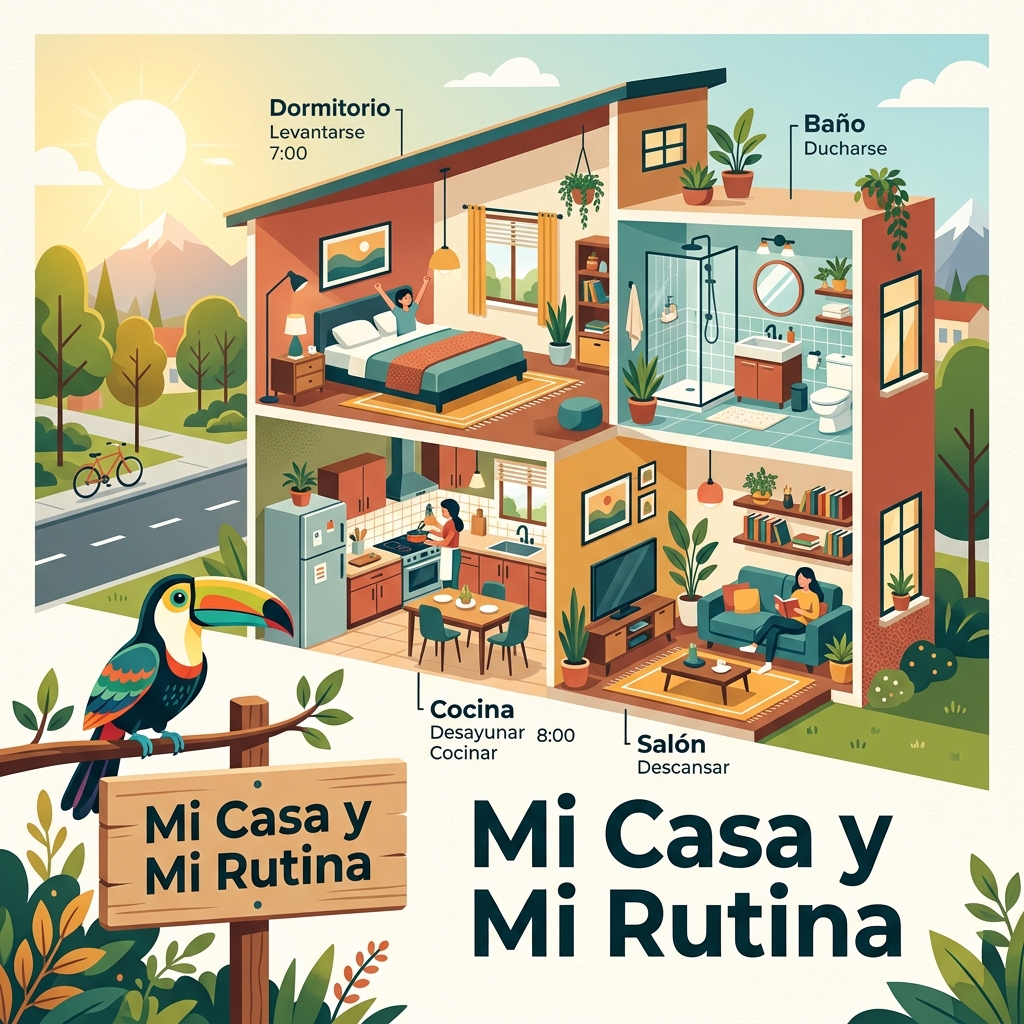
Extended Vocabulary, Grammar, Open Comprehension & Image Description — Level A1
Let's learn more words to describe what is inside a house and the actions we do in each room.
1. Extra Furniture and Objects (Más muebles y objetos)
| Spanish | English |
|---|---|
| La estantería | The bookshelf |
| La cortina | The curtain |
| El cuadro | The painting / picture |
| El reloj | The clock |
| La papelera | The wastebasket / trash can |
| El perchero | The coat rack |
| La chimenea | The fireplace |
| El radiador | The radiator |
2. Daily Actions in the House (Acciones diarias en la casa)
| Spanish | English | Typical Room |
|---|---|---|
| Dormir | To sleep | El dormitorio |
| Comer | To eat | El comedor / La cocina |
| Hacer los deberes | To do homework | El dormitorio / El salón |
| Lavarse los dientes | To brush one's teeth | El baño |
| Ducharse / Bañarse | To take a shower / bath | El baño |
| Ver la tele | To watch TV | El salón |
| Escuchar música | To listen to music | El dormitorio / El salón |
1. SER, ESTAR, and HAY (Review)
• HAY (There is / There are) — Used for existence and quantity.
Ejemplo: Hay un reloj en la pared. (There is a clock on the wall.)
• ESTAR (Location / State) — Used for where things are located.
Ejemplo: La silla está en el balcón. (The chair is on the balcony.)
• SER (Description / Identity) — Used to describe essential characteristics.
Ejemplo: La calle es ancha. (The street is wide.)
2. Question Words (Palabras Interrogativas)
To ask about a house, you need these basic question words:
| Question Word | Meaning | Example |
|---|---|---|
| ¿Qué? | What? | ¿Qué es esto? / ¿Qué hay en el salón? |
| ¿Dónde? | Where? | ¿Dónde está el baño? |
| ¿Cómo? | How / What is it like? | ¿Cómo es tu casa? |
Exercise A: Mandy's New Flat — Read the dialogue between Vicky and Mandy about Mandy's new flat. Then answer the questions in Spanish with your own words.
Vicky: Oye, ¿qué tal el nuevo piso?
Mandy: Sí, pues nosotros estamos muy contentos. Es precioso y muy grande.
Vicky: Cuéntame más detalles. ¿Cómo es?
Mandy: El piso está en el cuarto nivel, por eso, hay mucha luz. El salón está al lado del comedor y enfrente del comedor está la cocina. En el salón hay dos ventanas muy grandes.
Vicky: ¿Y cuántos dormitorios hay?
Mandy: Hay tres dormitorios: un dormitorio para nosotros que es el más grande, uno para nuestra hija y el otro es para los huéspedes (guests).
Vicky: ¡Qué lujo! ¿Y los baños?
Mandy: Hay dos baños. En el nuestro hay una bañera y en el de la niña hay una ducha.
Responde a las preguntas basándote en la lectura anterior (escribe con tus propias palabras en español):
Exercise B: Match the Action to the Room
Where do people usually do these activities? Write the correct room in Spanish using the word bank.
Exercise C: Fill in the Blanks (SER, ESTAR, HAY)
Write the correct verb (es / son / está / están / hay) for each sentence.
Exercise E: Word Translation
Translate these objects found in a house into English.
Exercise F: Describe Your Routine at Home!
Write 5 to 6 sentences about what you do in your house. Use action verbs (comer, dormir, ver la tele, ducharse) and mention the rooms!
Requirements:
• Include at least 3 different rooms
• Include at least 2 different action verbs
• Include at least one sentence using hay, ser, or estar to describe your house.
Example: "Por la mañana, yo me ducho en el baño. Luego, yo como en la cocina..."
Reserva tu clase personalizada de español con Camilo y domina la gramática real de forma fluida.
aprendecontucaneo@gmail.com
tucaneo.com