Hoja de Trabajo A1
¡Ay, me duele todo! En el Médico
DOLER · TENER · ESTAR + Vocabulario Médico
Grammar, Reading & Practice — Level A1


Grammar, Reading & Practice — Level A1
1. Body Parts (Las Partes del Cuerpo)
| Español | English | Español | English |
|---|---|---|---|
| la cabeza | the head | el brazo | the arm |
| el cuello | the neck | la mano / los dedos | the hand / fingers |
| la garganta | the throat | el estómago | the stomach |
| los ojos | the eyes | la espalda | the back |
| la nariz | the nose | la rodilla | the knee |
| la boca | the mouth | la pierna | the leg |
| los dientes | the teeth | el pie / los pies | the foot / feet |
| el pecho | the chest | los oídos | the ears |
2. At the Doctor's Office (En la Consulta)
| Español | English | Español | English |
|---|---|---|---|
| el médico / la doctora | the doctor | la fiebre | the fever |
| la cita | the appointment | la tos | the cough |
| la receta | the prescription | la gripe | the flu |
| el jarabe | the syrup | las náuseas | the nausea |
| las pastillas | the pills | el resfriado | the cold |
| la inyección | the shot | el dolor | the pain |
Three Key Verbs for Health & Medical Consultations:
• DOLER ➔ Physical pain (acts like gustar — changes according to singular/plural noun!).
Ejemplo: Me duele la cabeza. / Me duelen los pies.
• TENER ➔ Symptoms you "have" (fiebre, tos, gripe, náuseas).
Ejemplo: Tengo fiebre y tos.
• ESTAR ➔ Current state or condition (enfermo, cansado, mareado).
Ejemplo: Estoy muy cansado/a.
| DOLER (to hurt) | TENER (to have) | ESTAR (to be) |
|---|---|---|
| me duele (sing.) / me duelen (plur.) | yo tengo | yo estoy |
| te duele / te duelen | tú tienes | tú estás |
| le duele / le duelen | él / ella tiene | él / ella está |
| nos duele / nos duelen | nosotros tenemos | nosotros estamos |
01 — Sort It Out!
Look at the word bank below. Select or write each word in the correct column: ME DUELE / DUELEN, TENGO, or ESTOY.
Word bank: fiebre — la cabeza — cansado/a — tos — la rodilla — gripe — los pies — mareado/a — náuseas — la garganta — enfermo/a — la espalda
| ME DUELE / DUELEN... | TENGO... | ESTOY... |
|---|---|---|
02 — Put the Dialogue in Order!
The doctor and patient are talking, but the lines are scrambled! Write numbers 1 to 6 in the boxes to show the correct order.
03 — Translate into Spanish!
Write each sentence in Spanish. Use DOLER, TENER, or ESTAR — and watch out for singular vs. plural!
1. My back hurts.
2. She has a fever and a cough.
3. We are very sick.
4. Do your feet hurt?
5. I have an appointment with the doctor at 9.
6. His stomach and his head hurt.
04 — Write a Google Maps Review for Dr. Horrorosa!
Look at this doctor's office. Someone needs to warn people on Google Maps! Write a review of 4–5 sentences.
Requirements: Include SER (x1) + ESTAR (x1) + HAY (x1) + DOLER or TENER to describe how you feel after visiting!
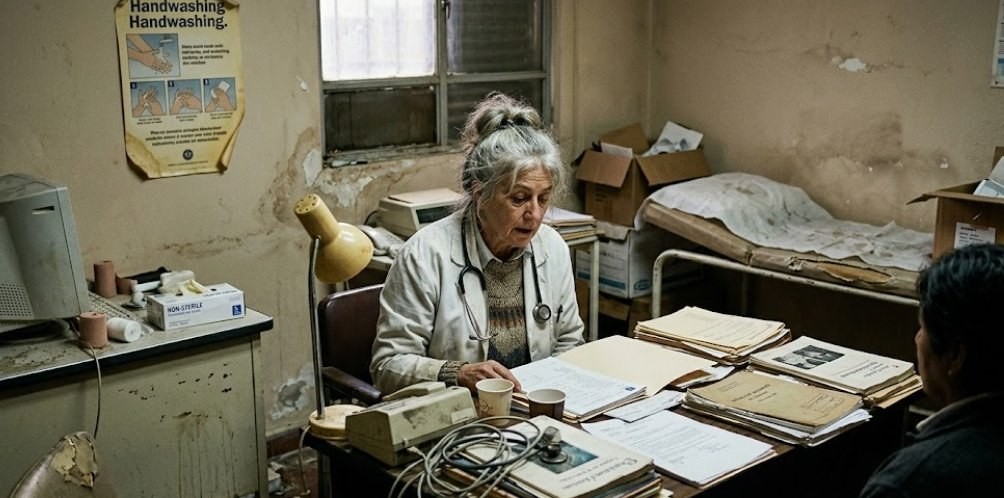
05 — ¿Qué les pasa a los pacientes?
Observa detenidamente la imagen de la sala de espera / consulta médica. Describe lo que le ocurre a cada uno de los tres pacientes (Roberto, Ana y Carlos) utilizando los verbos DOLER, TENER y ESTAR junto con el vocabulario médico y las partes del cuerpo.

| Incorrect | Correct | Why? |
|---|---|---|
| Me duele la cabeza. | "Cabeza" is singular ➔ duele | |
| Me duelen los pies. | "Pies" is plural ➔ duelen | |
| Me duele la cabeza. | Use DOLER for pain, not "tener dolor" | |
| Tengo fiebre. | Fever is a symptom ➔ TENER, not ESTAR | |
| Estoy enfermo. | Being sick is a temporary condition ➔ ESTAR |
Reserva tu clase personalizada de español con Camilo y domina la gramática real de forma fluida.
aprendecontucaneo@gmail.com
tucaneo.com