Español Nivel A1.2 · Vocabulario (Página 1)Spanish Level A1.2 · Vocabulary (Page 1)
Español para Viajar · Módulo 6 · Nivel A1.2
En el AeropuertoAt the Airport
Quiero, necesito, tengo que: del mostrador a la aduanaI want, I need, I have to: from check-in to customs
Tu amiga Laura vuela hoy de Miami a Cartagena, Colombia. Es su primer viaje sola y te escribe por WhatsApp en cada paso: el mostrador, la seguridad, la puerta… y un problema. Ayúdala a llegar.Your friend Laura is flying today from Miami to Cartagena, Colombia. It is her first trip alone and she texts you on WhatsApp at every step: check-in, security, the gate… and a problem. Help her get there.
Temas:Topics:Vocabulario del aeropuertoQuiero / necesito / tengo que + infinitivoLa hora y los números
Nombre del estudiante:Student Name:
Fecha:Date:
Vocabulario clave: léelo antes de empezarKey vocabulary: read it before you start
These are all the new words in this worksheet. Read them now and come back here when you need them.
El mostrador
La seguridad
La puerta
La llegada
el mostrador check-in counter
el control de seguridad security check
la puerta de embarque boarding gate
migración immigration
documentar la maleta to check a bag
la bandeja tray
la sala de espera waiting area
el motivo del viaje reason for the trip
la maleta de mano carry-on bag
el portátil laptop
la pantalla de salidas departures board
quedarse to stay (time)
pesar to weigh
los líquidos liquids
el asiento: pasillo / ventanilla seat: aisle / window
hospedarse to stay (at a hotel)
el máximo the maximum
quitarse (los zapatos) to take off (shoes)
retrasado / a tiempo delayed / on time
la recogida de equipaje · la banda baggage claim · belt
la tarjeta de embarque boarding pass
tirar to throw away
el enchufe power outlet
la aduana · declarar customs · to declare
It changes by country:documentar la maleta (Latin America) = facturar (Spain) · el boleto (Mexico) = el tiquete (Colombia) = el billete (Spain) · la banda = la cinta.
En el Aeropuerto
Español Nivel A1.2 · Lugares y estructura (Página 2)Spanish Level A1.2 · Places & structure (Page 2)
1Paso 1 · El mapa del aeropuertoStep 1 · The airport map
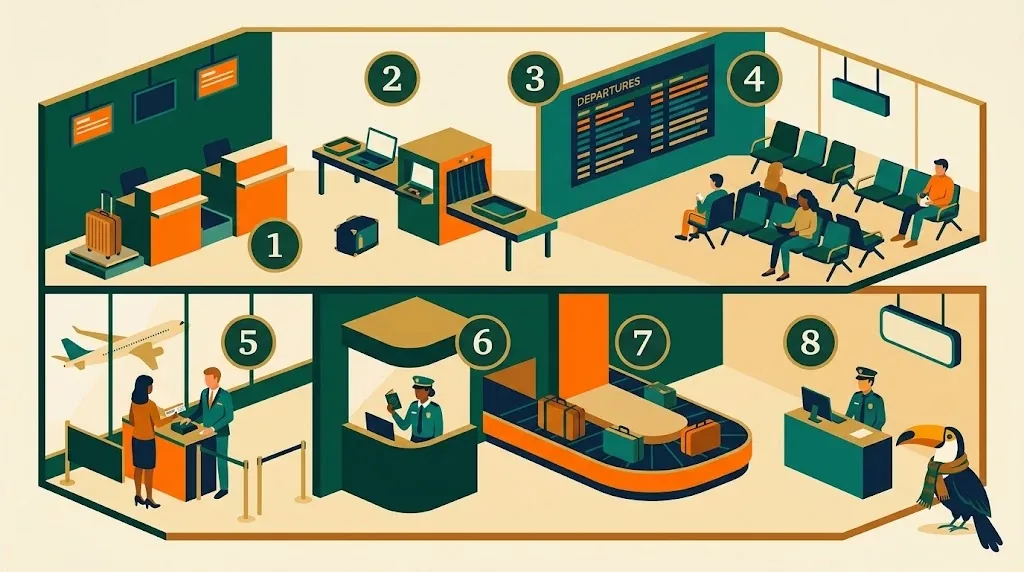
Laura¡Ya estoy en el aeropuerto de Miami! Es enorme Te mando el plano. ¿Dónde está todo?I'm at Miami airport! It's huge. I'm sending you the map. Where is everything?
Look at Laura's map and read the clue for each number. Write the place from the word bank.
Clic para ampliarClick to enlarge
Banco de palabras:la aduanala sala de esperael mostradorla recogida de equipajela pantalla de salidasmigraciónel control de seguridadla puerta de embarque
1. Aquí documentas tu maleta y recibes la tarjeta de embarque.
Here you check your bag and get your boarding pass.
2. Aquí pones el portátil y los líquidos en una bandeja.
Here you put your laptop and liquids in a tray.
3. Aquí lees la hora y la puerta de tu vuelo.
Here you read the time and the gate of your flight.
4. Aquí esperas sentado o sentada antes del vuelo.
Here you wait, sitting down, before the flight.
5. Aquí muestras la tarjeta de embarque y entras al avión.
Here you show your boarding pass and get on the plane.
6. Aquí un oficial mira tu pasaporte y pregunta el motivo del viaje.
Here an officer looks at your passport and asks the reason for your trip.
7. Aquí esperas tu maleta en la banda.
Here you wait for your bag on the belt.
8. Aquí declaras las cosas que traes de otro país.
Here you declare the things you bring from another country.
Quiero, necesito, tengo que + infinitivoI want, I need, I have to + infinitive
Quiero + infinitivo
Something you wish or choose.
Quiero un asiento de ventanilla. Quiero comer algo.
Necesito + infinitivo
Something that is necessary for you. Also with a thing: necesito agua.
Necesito cargar el celular. Necesito ir al baño.
Tengo que + infinitivo
An obligation or a rule. The agent says: usted tiene que…Tengo que mostrar el pasaporte. Usted tiene que pagar.
querer
necesitar
tener que
yo
quiero
necesito
tengo que
tú
quieres
necesitas
tienes que
usted / él / ella
quiere
necesita
tiene que
nosotros/as
queremos
necesitamos
tenemos que
ustedes / ellos / ellas
quieren
necesitan
tienen que
Careful with the negative:No tengo que pagar = it is not obligatory (I don't have to). No quiero pagar = I don't like the idea (I don't want to).
Fixed phrases:Aquí tiene mi pasaporte (here you are) · No tengo nada que declarar · ¿Puede repetir, por favor?
En el Aeropuerto
Español Nivel A1.2 · Paso 2: el mostrador (Página 3)Spanish Level A1.2 · Step 2: check-in (Page 3)
2Paso 2 · La cadena de la maletaStep 2 · The suitcase chain
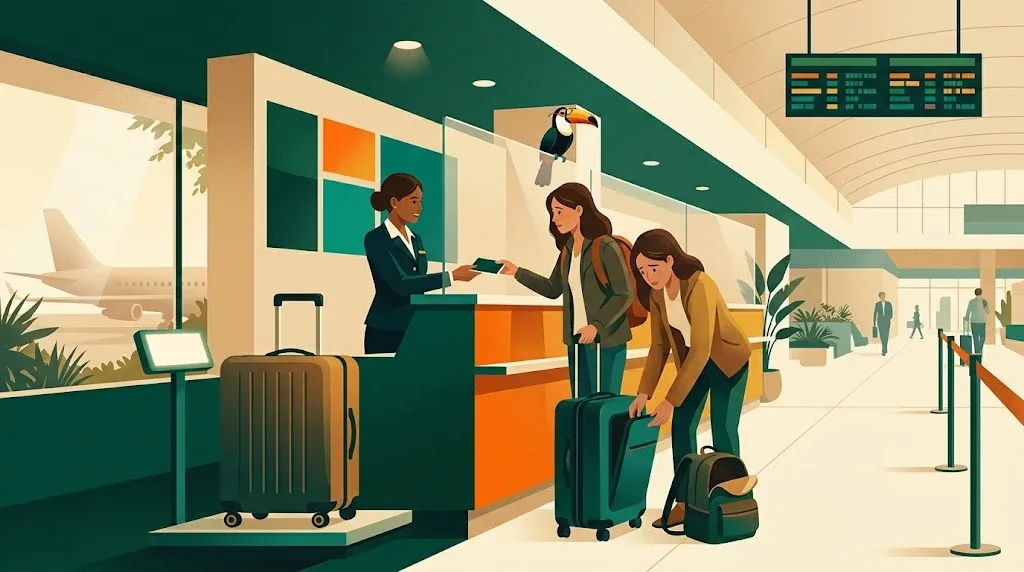
Clic para ampliarClick to enlarge
LauraEstoy en el mostrador. ¡Problema con la maleta! Mira lo que pasa.I'm at the check-in counter. A problem with my suitcase! Look what happens.
Agente: ¡Buenos días! ¿A dónde viaja hoy? Laura: A Cartagena. Aquí tiene mi pasaporte. Agente: Gracias. ¿Va a documentar maletas? Laura: Sí, quiero documentar esta maleta. Agente: Pesa 25 kilos y el máximo es 23. Usted tiene que pagar 60 dólares. Laura: Uy, no quiero pagar. Prefiero sacar unas cosas y ponerlas en mi mochila. Agente: Perfecto. Ahora pesa 22 kilos: no tiene que pagar. ¿Prefiere pasillo o ventanilla? Laura: Pasillo, por favor. Necesito caminar un poco en el vuelo. Agente: Muy bien, asiento 23C. El embarque es a las nueve y cuarto, en la puerta B12. Laura: ¿Tengo que pasar por el control de seguridad ahora? Agente: Sí, y tiene que estar en la puerta treinta minutos antes del embarque. ¡Buen viaje!
Mini glossary: sacar = to take out · la mochila = backpack · ponerlas = to put them · caminar = to walk
Each event causes the next one. Use the dialogue and write the missing words in each link (1 to 3 words). In class, tell the whole story with primero, después, al final.
1 La maleta pesa 25 kilos.
→
2 Laura tiene que 60 dólares.
→
3 Pero Laura no pagar.
→
4 Saca unas cosas y las pone en su .
→
5 Ahora la maleta pesa kilos.
→
6 Al final, Laura no pagar.
Datos para el resto del viaje:Details for the rest of the trip:asientoseat (pasillo o ventanillaaisle or window: ) · embarque a lasboarding at · puertagate
3En la fila del mostrador: ¿quiero, necesito o tengo que?In the check-in line: quiero, necesito or tengo que?
While she waits, Laura hears the other passengers. Decide the verb by its meaning (wish, need or obligation) and conjugate it. The person is in brackets.
Verbos:querernecesitartener que
1. Mi maleta pesa 25 kilos y el máximo es 23. (yo) pagar 60 dólares.
2. Tengo mucha sed. (yo) comprar agua.
3. Es una regla: todos los pasajeros (ellos) poner los líquidos en una bandeja.
4. Mi celular tiene 3 % de batería. (yo) cargarlo.
5. A mi hija le gusta mirar las nubes. (ella) sentarse en la ventanilla.
6. Señor, es obligatorio: (usted) mostrar su pasaporte.
7. Tenemos tiempo y nos gusta la comida mexicana. (nosotros) comer en el restaurante.
8. El vuelo sale en dos horas. No (nosotros) correr.
En el Aeropuerto
Español Nivel A1.2 · Paso 3: seguridad y puerta (Página 4)Spanish Level A1.2 · Step 3: security and gate (Page 4)
4Paso 3 · Transforma los carteles de seguridadStep 3 · Transform the security signs
Laura sends you photos of the signs at security. Transform each sign into what Laura says, with yo. The clue tells you the form: ¿…? (a question), quiero, necesito, tengo que or no tengo que.
1. «Pasajeros: tienen que quitarse los zapatos.» (Laura no está segura: ¿…?)
"Passengers: you have to take off your shoes." (Laura isn't sure: a question)
2. «Hay enchufes en la sala de espera.» (su celular tiene 3 %: necesito)
"There are outlets in the waiting area." (her phone is at 3%: necesito)
3. «Café y comida: segundo piso.» (Laura tiene hambre: quiero)
"Coffee and food: second floor." (Laura is hungry: quiero)
4. «Maleta de mano: máximo 10 kilos. Más kilos: usted tiene que pagar.» (su mochila pesa 9 kilos: no tengo que)
"Carry-on: 10 kilos maximum. More kilos: you have to pay." (her backpack weighs 9 kilos: no tengo que)
5. «Líquidos: máximo 100 ml. Usted tiene que tirar las botellas grandes.» (Laura tiene una botella de un litro: tengo que)
"Liquids: 100 ml maximum. You have to throw away big bottles." (Laura has a one-liter bottle: tengo que)
6. «Portátiles: fuera de la maleta, en una bandeja.» (es una regla: tengo que)
"Laptops: out of the bag, in a tray." (it's a rule: tengo que)
En clase:In class:¿Y tú? ¿Qué tienes que hacer en el control de seguridad de tu aeropuerto?And you? What do you have to do at security in your airport?
5El chat de Laura desde la puertaLaura's chat from the gate
Laura sends you her boarding pass, a photo of the departures board and her notes for immigration. Answer each message in 1 to 6 words.
Tarjeta de embarque · TC 437
Miami (MIA) → Cartagena (CTG) · 14 de noviembre
Embarque 9:15 · Salida 9:45
Puerta B12 · Asiento 23C · Grupo 3
1 maleta documentada (máx. 23 kg) + 1 maleta de mano (máx. 10 kg)
Salidas · Departures
TC 437
Cartagena
10:30
B20
RETRASADO
AV 215
Bogotá
10:00
B14
A TIEMPO
CM 381
Panamá
10:15
C3
EMBARCANDO
TC 512
Lima
10:40
B12
A TIEMPO
Notas de Laura para migración:Laura's notes for immigration: turismo · dos semanas en Colombia · Hotel Casa del Mar · nada que declarar
Laura · 1¿Cuántos kilos puede pesar mi maleta de mano?
How many kilos can my carry-on weigh?
Laura · 2Mira la pantalla. ¿A qué hora sale mi vuelo ahora?
Look at the board. What time does my flight leave now?
Laura · 3¿A qué puerta tengo que ir?
Which gate do I have to go to?
Laura · 4Hay mucha gente en una puerta. ¿Qué vuelo está embarcando?
There are a lot of people at one gate. Which flight is boarding?
Laura · 5En Cartagena el oficial va a preguntar: «¿Cuál es el motivo de su viaje?» ¿Qué contesto?
In Cartagena the officer is going to ask: "What is the reason for your trip?" What do I answer?
Laura · 6«¿Cuánto tiempo va a quedarse en Colombia?» ¿Qué contesto?
"How long are you going to stay in Colombia?" What do I answer?
Laura · 7«¿Dónde va a hospedarse?» ¿Qué contesto?
"Where are you going to stay?" What do I answer?
Laura · 8«¿Tiene algo que declarar?» ¿Qué contesto?
"Do you have anything to declare?" What do I answer?
En clase:In class:¿Y tú? ¿Cuál es el motivo de tu próximo viaje? ¿Cuánto tiempo vas a quedarte?And you? What is the reason for your next trip? How long are you going to stay?
En el Aeropuerto
Español Nivel A1.2 · Paso 4: el retraso (Página 5)Spanish Level A1.2 · Step 4: the delay (Page 5)
Paso 4 · El vuelo de Laura tiene retraso
Dos horas en la sala de esperaTwo hours in the waiting area
Review (module 5): what is happening now?estar + -ando / -iendo El hombre está esperando. Los niños están comiendo. Ella está durmiendo.
6Describe la sala de esperaDescribe the waiting area
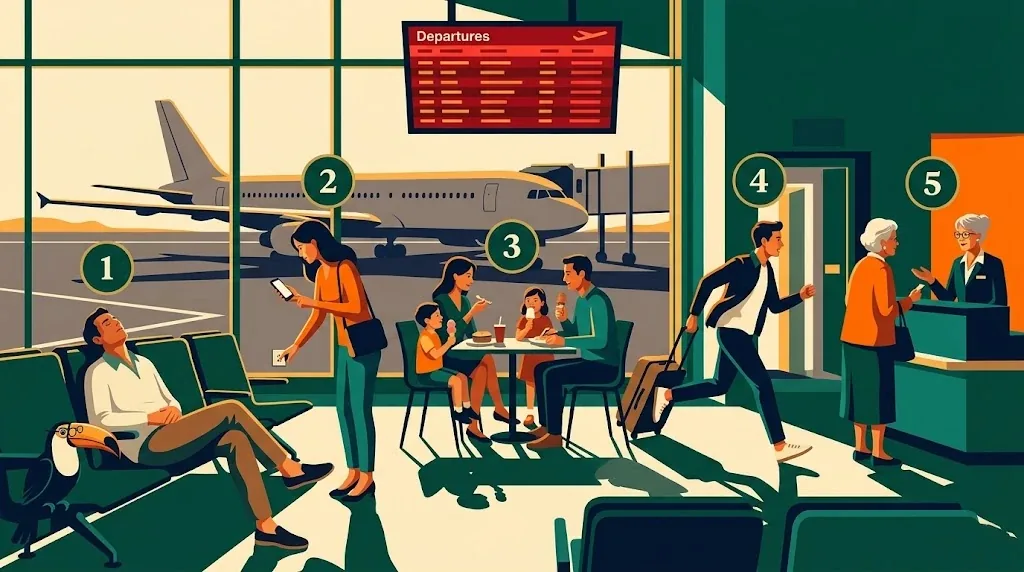
Laura¡Mi vuelo está retrasado! Estoy en la sala de espera. Te mando una foto: aquí todos están haciendo algo.My flight is delayed! I'm in the waiting area. I'm sending you a photo: everyone here is doing something.
Look at Laura's photo. For each person, write what he or she is doing and what he or she wants, needs or has to do. Use the clue words. In class, tell your teacher about the picture.
Clic para ampliarClick to enlarge
1. el hombre · dormir · descansar
the man · to sleep · to rest
2. la mujer · buscar un enchufe · cargar el celular
the woman · to look for an outlet · to charge the phone
3. la familia · comer · un helado
the family · to eat · an ice cream
4. el chico · correr · llegar a la puerta B20
the young man · to run · to get to gate B20
5. la señora · hablar con el agente · saber la nueva hora
the lady · to talk to the agent · to know the new time
6. En la sala de espera hay…
In the waiting area there is / there are…
7¿Qué hace Laura? Decide y explicaWhat does Laura do? Decide and explain
Laura asks you for help. Tell her what she has to do (tienes que…), give her your idea and say why. Model: Laura, tienes que esperar dos horas. Mi idea: comer en un restaurante, porque tienes hambre. Your answer to number 4 decides the end of the trip (page 6).
1. El vuelo de Laura tiene un retraso de dos horas.
a) comer en un restaurante · b) dormir en la sala de espera · c) comprar un libro
Laura's flight is two hours late. a) eat at a restaurant · b) sleep in the waiting area · c) buy a book
2. Laura tiene hambre, pero en el aeropuerto un sándwich cuesta 15 dólares.
a) comprar el sándwich · b) esperar y comer en Cartagena
Laura is hungry, but at the airport a sandwich costs 15 dollars. a) buy the sandwich · b) wait and eat in Cartagena
3. Laura no entiende la nueva hora del vuelo. La agente habla muy rápido.
a) preguntar: «¿Puede repetir, por favor?» · b) mirar la pantalla de salidas
Laura doesn't understand the new flight time. The agent speaks very fast. a) ask: "Can you repeat, please?" · b) look at the departures board
4. El vuelo de Laura cambia a la puerta B20. Laura está en la B12, faltan 15 minutos y necesita ir al baño.
a) correr a la B20 · b) ir al baño primero
Laura's flight changes to gate B20. She is at B12, there are 15 minutes left and she needs the restroom. a) run to B20 · b) go to the restroom first
En el Aeropuerto
Español Nivel A1.2 · Paso 5: Cartagena (Página 6)Spanish Level A1.2 · Step 5: Cartagena (Page 6)
Paso 5 · ¿Llega Laura al final?Step 5 · Does Laura make it in the end?
Read the end for your answer to number 4 (page 5). Then complete Laura's last message with por or para (review, module 3).
Laura · si eliges a)if you chose a)¡Estoy en el avión! Asiento 23C, pasillo. ¡Perfecto! I'm on the plane! Seat 23C, aisle. Perfect!
Laura · si eliges b)if you chose b)Estoy en la puerta B20… y el avión está saliendo Tengo que esperar el próximo vuelo. Pero hay un café muy bueno aquí.I'm at gate B20… and the plane is leaving. I have to wait for the next flight. But there is a very good café here.
Laura · en Cartagena (más temprano o más tarde)in Cartagena (sooner or later)¡Hola desde Cartagena! Gracias tu ayuda. Tengo un regalo ti: ¡un sombrero! Mañana paso el centro histórico.
Hi from Cartagena! Thanks ___ your help. I have a present ___ you: a hat! Tomorrow I go ___ the old town.
Review (module 3):para + the person who receives something (para ti) · por + the reason (gracias por…) or the place you go through (paso por…)
8Tú y los aeropuertos: tira el dadoYou and airports: roll the die
Roll the die 3 times (button, a real die, or your teacher says a number from 1 to 6). Answer those 3 questions in the notebook below, 2 lines each. In class, your teacher asks you the other 3.
⚀ 1. ¿Qué necesitas siempre en tu maleta de mano?
What do you always need in your carry-on?
⚁ 2. ¿Qué tienes que hacer antes de un vuelo internacional?
What do you have to do before an international flight?
⚂ 3. ¿Prefieres pasillo o ventanilla? ¿Por qué?
Do you prefer aisle or window? Why?
⚃ 4. ¿Qué es más estresante para ti: el control de seguridad o migración?
What is more stressful for you: security or immigration?
⚄ 5. ¿Qué no te gusta hacer en el aeropuerto?
What don't you like doing at the airport?
⚅ 6. ¿A dónde quieres viajar el próximo año? ¿Qué necesitas para ese viaje?
Where do you want to travel next year? What do you need for that trip?
Lista de verificación A1.2:A1.2 Checklist:
In my 3 answers I use quiero, necesito and tengo que + infinitive at least once each.
I write one negative sentence: no tengo que… or no quiero…
I explain one answer with porque and use one airport word from page 1.
Mis 3 respuestas del dadoMy 3 dice answersObjetivo: 6 líneasTarget: 6 lines
Respuestas y Autocorrección (Haz clic para revisar)Answer Key & Self-Check (Click to expand)
Ejercicio 1: 1. el mostrador · 2. el control de seguridad · 3. la pantalla de salidas · 4. la sala de espera · 5. la puerta de embarque · 6. migración · 7. la recogida de equipaje · 8. la aduana
Ejercicio 2: 2. pagar · 3. quiere · 4. mochila · 5. 22 · 6. tiene que · Datos: asiento 23C (pasillo) · embarque a las 9:15 (las nueve y cuarto) · puerta B12
Ejercicio 3: 1. Tengo que · 2. Quiero (también: Necesito) · 3. tienen que · 4. Necesito (también: Tengo que) · 5. Quiere · 6. tiene que · 7. Queremos · 8. tenemos que
Ejercicio 4: 1. ¿Tengo que quitarme los zapatos? · 2. Necesito cargar el celular. · 3. Quiero comer algo. (también: Quiero un café.) · 4. No tengo que pagar. · 5. Tengo que tirar la botella. · 6. Tengo que poner el portátil en una bandeja.
Ejercicio 5: 1. 10 kilos · 2. A las 10:30 (las diez y media) · 3. A la B20 · 4. El vuelo a Panamá · 5. Turismo. · 6. Voy a quedarme dos semanas. · 7. En el Hotel Casa del Mar. · 8. No, no tengo nada que declarar.
Ejercicio 6 (modelo): 1. El hombre está durmiendo. Está cansado y necesita descansar. · 2. La mujer está buscando un enchufe. Necesita cargar el celular. · 3. La familia está comiendo. Los niños quieren un helado. · 4. El chico está corriendo. Tiene que llegar a la puerta B20. · 5. La señora está hablando con el agente. Quiere saber la nueva hora del vuelo. · 6. En la sala de espera hay muchas personas, una pantalla y una ventana grande.
Ejercicio 7 (modelo): 1. Laura, tienes que esperar dos horas. Mi idea: comprar un libro, porque te gusta leer. · 2. Tienes que pagar 15 dólares o esperar. Mi idea: esperar y comer en Cartagena, porque el sándwich es muy caro. · 3. Tienes que saber la nueva hora. Mi idea: mirar la pantalla, porque la agente habla muy rápido. (También: preguntar «¿Puede repetir, por favor?».) · 4. Tienes que llegar a la B20 en 15 minutos. Mi idea: correr a la B20, porque no quieres perder el vuelo.
Final del caso (repaso por / para): Gracias por tu ayuda · un regalo para ti · paso por el centro histórico
Ejercicio 8 (modelo): 1. En mi maleta de mano siempre necesito mi pasaporte, el celular y un libro. · 3. Prefiero la ventanilla porque me gusta mirar las nubes. No quiero el pasillo. · 6. El próximo año quiero viajar a México. Tengo que buscar un hotel y necesito un pasaporte nuevo.
Recursos Exclusivos Tucaneo
Desbloquea los ejercicios interactivos y recursos prácticos Unlock interactive exercises and practice resources
Ingresa tu correo para acceder al material completo de esta lección y recibir novedades de nuestros grupos reducidos de conversación.Enter your email to access the full lesson material and get priority updates on our Small Conversation Groups.
Sin spam. Cancela cuando quieras.No spam. Unsubscribe anytime.
¿Quieres viajar hablando español?Want to travel speaking Spanish?
Agenda tu clase personalizada con Camilo y practica el aeropuerto, el hotel y el taxi con situaciones reales.Book your 1-on-1 class with Camilo and practice the airport, the hotel and the taxi with real situations.
aprendecontucaneo@gmail.com
tucaneo.com
Guarda tu progreso
Tus respuestas no se guardan en el servidor.
Para no perder tu trabajo, presiona "Guardar como PDF" abajo (o Ctrl/Cmd + P).
Elige "Guardar como PDF" como destino.
Envía el PDF a tu profesor: aprendecontucaneo@gmail.com
Imagen ampliada · Haz clic afuera o presiona ESC para cerrarExpanded image · Click outside or press ESC to close
Sigue practicando español para viajarKeep practicing Spanish for travel
Tres materiales del mismo módulo, gratis y sin registrarte.Three more materials from this module — free, no sign-up.
Finished this worksheet? Let’s practice speaking it out loud!
Hi, I’m Camilo — I made this worksheet. In a free 20-minute call I’ll check your level and show you exactly how to start speaking. No pressure, no commitment.
¿Eres abogado o profesional de negocios? Conoce nuestro programa especializado: Español Jurídico B2B.Are you an attorney or business professional? Explore our specialized B2B Legal Spanish Program: Legal Spanish for Lawyers.

 El camino al aeropuertoJuego
 Tiquetes y horariosWorksheet
 Perdido en CartagenaWorksheet · A1.2