Español Nivel A2 · Un mes con la suegra (Página 1)Spanish Level A2 · A month with the mother-in-law (Page 1)
Hoja de trabajo · Nivel A2 · Presente de subjuntivoPresent subjunctive
Quiero que vengas: presente de subjuntivoQuiero que vengas: the present subjunctive
Un mes con la suegra: querer que, esperar que y ojalá con verbos regulares e irregularesA month with the mother-in-law: querer que, esperar que and ojalá with regular and irregular verbs
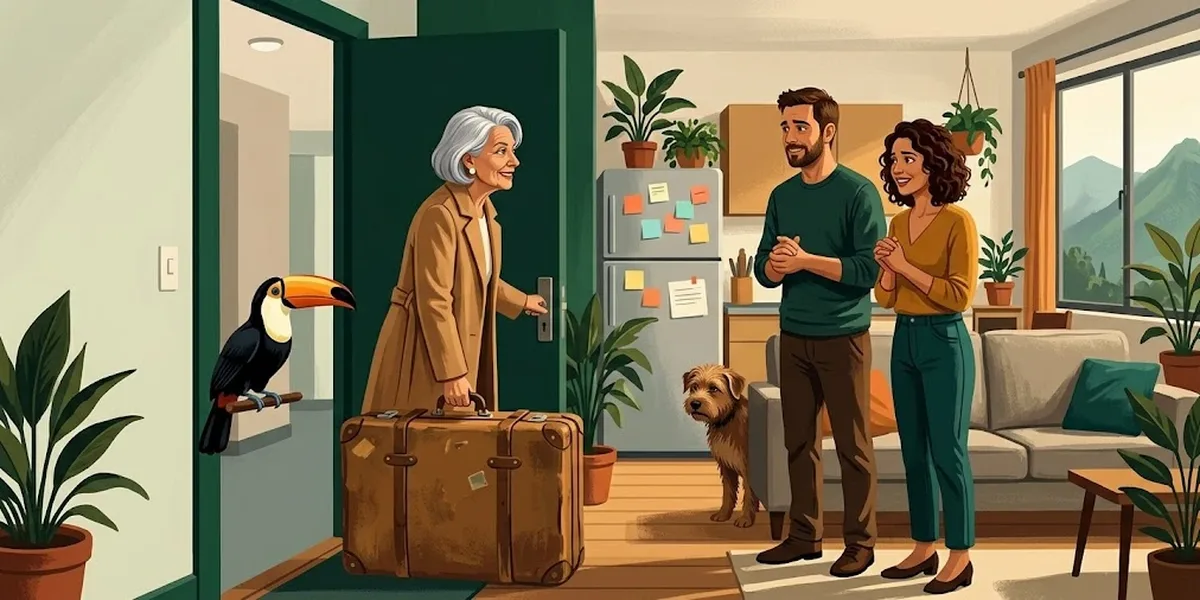
Daniel y Sara viven en un apartamento pequeño en Bogotá con Toby, un perro grande y nervioso. El lunes llega Doña Rosa, la mamá de Sara, y se queda un mes. Doña Rosa tiene muchos deseos y los escribe en notas en la nevera. Daniel también tiene deseos… pero los tiene en una lista secreta.Daniel and Sara live in a small apartment in Bogotá with Toby, a big, nervous dog. On Monday Doña Rosa, Sara’s mom, arrives and stays for a month. Doña Rosa has a lot of wishes and writes them on notes on the fridge. Daniel has wishes too… but he keeps them on a secret list.
Temas:Topics:Quiero que + subjuntivoEspero que · OjaláVerbos irregularesRepaso: gustar
Nombre del estudiante:Student Name:
Fecha:Date:
Así funciona esta hoja:How this worksheet works:1. El reto1. The challenge → 2. El recordatorio2. The reminder → 3. La revancha3. The rematch → 4. Práctica4. Practice → 5. Ranking5. Ranking → 6. Tu nota6. Your note
Vocabulario clave: léelo antes de empezarKey vocabulary: read it before you start
La visitaThe visit
En la casaAt home
Doña RosaDoña Rosa
Para desearWishing
la suegra· mother-in-law
la nevera· fridge
madrugar· to get up early
ojalá (que)· I really hope, let’s hope
quedarse· to stay
la nota· note
la telenovela· soap opera
esperar que· to hope that
el invitado · la invitada· guest
lavar los platos· to do the dishes
ir a misa· to go to Mass
querer que· to want (someone) to
la maleta· suitcase
el control remoto· remote control
el mercado· market
estricto · estricta· strict
el sofá cama· sofa bed
el balcón· balcony
el ajiaco· Bogotá chicken and potato soup
tener miedo de· to be afraid of
Quiero que vengas
Español Nivel A2 · El reto de la nevera (Página 2)Spanish Level A2 · The fridge challenge (Page 2)
Lunes, 8:00 · El reto: antes de la reglaMonday, 8:00 · The challenge: before the rule
Las notas de Doña RosaDoña Rosa’s notes
1El reto: completa las notas de la neveraThe challenge: complete the notes on the fridge
Doña Rosa llega el lunes a las 7 y a las 8 ya hay seis notas en la nevera. Todavía no mires la regla. Escribe el verbo en presente de subjuntivo. Si no estás seguro, marca la casilla: es normal, es un reto.Doña Rosa arrives on Monday at 7 and by 8 there are already six notes on the fridge. Don’t look at the rule yet. Write the verb in the present subjunctive. If you are not sure, tick the box: that’s normal, it’s a challenge.
1.Quiero que ustedes (desayunar) a las 6 de la mañana. (I want you all to … at 6 in the morning.)
2.Espero que Toby no (dormir) en mi cama. (I hope Toby doesn’t … in my bed.)
3.Quiero que Daniel (venir) conmigo al mercado. (I want Daniel to … with me to the market.)
4.Ojalá que el domingo (hacer) sol. (I hope it’s … sunny on Sunday.)
5.Espero que Sara (saber) hacer ajiaco. (I hope Sara … how to make ajiaco.)
6.Quiero que la cocina (estar) limpia. ¡Siempre! (I want the kitchen to … clean. Always!)
Mi marcador del reto:My challenge score:Antes de la reglaBefore the rule / 6Después de la revancha (página 3)After the rematch (page 3) / 6
¿Cuál es tu trampa? Mira la clave del ejercicio 1 y marcaWhat is your trap? Check the key for exercise 1 and tick
Con el profe (1 minuto):With the teacher (1 minuto):¿Qué nota de Doña Rosa te parece normal y cuál te parece exagerada? Después, pasa a la página 3: ahí está el recordatorio.Which of Doña Rosa’s notes seems normal to you and which one seems too much? Then go to page 3: the reminder is there.
Quiero que vengas
Español Nivel A2 · El recordatorio y la revancha (Página 3)Spanish Level A2 · The reminder and the rematch (Page 3)
Lunes, 9:00 · El recordatorioMonday, 9:00 · The reminder
Lo que ya sabes del subjuntivo, en una páginaWhat you already know about the subjunctive, on one page
1. La fórmula: dos personas1. The formula: two people persona 1person 1 + quiero que · espero que · ojalá (que) + persona 2 + subjuntivoperson 2 + subjunctive ✓ Doña Rosa quiere que Daniel venga. · ✓ Quiero dormir. (una persona = infinitivo) · ✗ Quiero que yo duerma.✓ Doña Rosa quiere que Daniel venga. · ✓ Quiero dormir. (one person = infinitive) · ✗ Quiero que yo duerma. I want you to come. → Quiero que vengas. (en inglés: to + verbo; en español: que + subjuntivo)(English uses to + verb; Spanish uses que + subjunctive)
2. Los regulares: la vocal cambia de equipo2. Regular verbs: the vowel switches teams
PersonaPerson
-ar → e (desayunar)
-er → a (comer)
-ir → a (vivir)
yo
desayune
coma
viva
tú
desayunes
comas
vivas
él · ella · usted
desayune
coma
viva
nosotros · nosotras
desayunemos
comamos
vivamos
ellos · ellas · ustedes
desayunen
coman
vivan
3. La regla del yo: toma «yo» del presente, quita la -o y pon -a3. The “yo” rule: take “yo” in the present, drop the -o and add -a
VerboVerb
yo (presente)yo (present)
subjuntivosubjunctive
venir
vengo
venga, vengas…
hacer
hago
haga, hagas…
tener
tengo
tenga, tengas…
salir
salgo
salga, salgas…
VerboVerb
yo (presente)yo (present)
subjuntivosubjunctive
poner
pongo
ponga, pongas…
traer
traigo
traiga, traigas…
dormir
duermo
duerma, duermas…
querer
quiero
quiera, quieras…
4. Los 6 rebeldes: estos no siguen la regla4. The 6 rebels: these don’t follow the rule
RebeldeRebel
yo
tú
él · ellahe · she
nosotros
ellos · ustedesthey · you all
ser
sea
seas
sea
seamos
sean
estar
esté
estés
esté
estemos
estén
ir
vaya
vayas
vaya
vayamos
vayan
dar
dé
des
dé
demos
den
saber
sepa
sepas
sepa
sepamos
sepan
haber (hay)
haya · solo esta forma: «Ojalá que haya café.»only this form: “Ojalá que haya café.” (I hope there is coffee.)
La revancha:The rematch:vuelve a las notas de la página 2, corrige con otro color y escribe tu marcador «después».go back to the notes on page 2, correct them in another color and write your “after” score.
Quiero que vengas
Español Nivel A2 · Gustos y deseos secretos (Página 4)Spanish Level A2 · Likes and secret wishes (Page 4)
Martes · PrácticaTuesday · Practice
Lo que le gusta a Doña Rosa y lo que quiere DanielWhat Doña Rosa likes and what Daniel wants
2Repaso relámpago de gustar (A1.2): ¿me gusta o me gusta que?Flash review of gustar (A1.2): me gusta or me gusta que?
Escribe A si la persona hace la acción ella misma o le gusta una cosa (infinitivo o gusta / gustan). Escribe B si otra persona hace la acción (que + subjuntivo). Después escribe el verbo correcto.Write A if the person does the action herself or likes a thing (infinitive or gusta / gustan). Write B if another person does the action (que + subjunctive). Then write the correct verb.
Lo que dice Doña RosaWhat Doña Rosa says
A · B
VerboVerb
a. Me gusta (madrugar) ____ los domingos. (I like … on Sundays.)
b. Me gusta que Daniel (lavar) ____ los platos. (I like it when Daniel … the dishes.)
c. Me (gustar) ____ las telenovelas de la noche. (I … the evening soap operas.)
d. No me gusta que Toby (subir) ____ al sofá. (I don’t like it when Toby … onto the sofa.)
e. Me gusta (ir) ____ a misa a las 7. (I like … to Mass at 7.)
f. Me encanta que ustedes (ser) ____ tan amables. (I love that you all … so kind.)
Con el profe (2 minutos):With the teacher (2 minutos):completa en voz alta de dos formas: «Cuando tengo invitados, me gusta que…» y «…no me gusta que…». Escribe una aquí:complete out loud in two ways: “When I have guests, I like it when…” and “…I don’t like it when…”. Write one here:
3La lista secreta de DanielDaniel’s secret list
Daniel no dice nada… pero escribe sus deseos en el celular. Une las dos partes en una sola frase con subjuntivo.Daniel doesn’t say a word… but he writes his wishes on his phone. Join the two parts into one sentence with the subjunctive.
a. Mi suegra va al cine sola todas las tardes. (My mother-in-law goes to the movies alone every afternoon.)→ Ojalá que…
b. Ella no es muy estricta. (She isn’t very strict.)→ Espero que…
c. Sara le da el sofá cama a su mamá. (Sara gives the sofa bed to her mom.)→ Quiero que…
d. Hay partido de fútbol el domingo. (There is a soccer game on Sunday.)→ Ojalá que…
e. Ella sale mucho con sus amigas. (She goes out a lot with her friends.)→ Espero que…
f. Toby no tiene miedo de ella. (Toby isn’t afraid of her.)→ Ojalá que…
Con el profe (1 minuto):With the teacher (1 minuto):lee tu deseo favorito de Daniel. ¿Daniel exagera o tiene razón?read your favorite wish from Daniel. Is Daniel exaggerating or is he right?
Quiero que vengas
Español Nivel A2 · Respuestas y ranking (Página 5)Spanish Level A2 · Answers and ranking (Page 5)
Miércoles · La nevera está llenaWednesday · The fridge is full
Responde las notas y ordena los deseosAnswer the notes and rank the wishes
4Respuestas en la neveraAnswers on the fridge
Doña Rosa deja más notas. Pega tu respuesta al lado: empieza como dice la flecha y usa un verbo del banco.Doña Rosa leaves more notes. Stick your answer next to each one: start the way the arrow says and use a verb from the bank.
Banco de verbos:Verb bank: llover · traer · comprar · poder · estar · gustar
1.«Mañana llueve todo el día.» (Tomorrow it rains all day.)
→ Ojalá que no…
2.«Mi hermana Pilar viene el sábado con sus cuatro gatos.» (My sister Pilar is coming on Saturday with her four cats.)
→ Espero que…
3.«No hay café en la casa.» (There is no coffee in the house.)
→ Quiero que tú…
4.«El domingo voy al gimnasio por primera vez. Tengo 68 años.» (On Sunday I’m going to the gym for the first time. I’m 68.)
→ Espero que…
5.«Esta noche cocino yo: ¡sopa de cebolla para todos!» (Tonight I’m cooking: onion soup for everyone!)
→ Ojalá que…
Con el profe (3 minutos):With the teacher (3 minutos):lee tus respuestas en voz alta. El profe lee la nota de Doña Rosa y tú respondes sin mirar la hoja.read your answers out loud. The teacher reads Doña Rosa’s note and you answer without looking at the sheet.
5Ranking: ¿qué deseo de Doña Rosa es más absurdo?Ranking: which of Doña Rosa’s wishes is the most absurd?
Ordena los 8 deseos: 1 = el más razonable, 8 = el más absurdo.Rank the 8 wishes: 1 = the most reasonable, 8 = the most absurd.
A. Quiero que Toby duerma en el balcón. (I want Toby to sleep on the balcony.)
B. Espero que Daniel no vea fútbol en la sala. (I hope Daniel doesn’t watch soccer in the living room.)
C. Quiero que ustedes vayan a misa conmigo a las 7. (I want you all to go to Mass with me at 7.)
D. Ojalá que Sara tenga un bebé este año. (I hope Sara has a baby this year.)
E. Quiero que nadie toque el control remoto a las 8: ¡es la hora de mi telenovela! (I want nobody to touch the remote control at 8: it’s time for my soap opera!)
F. Espero que la casa esté limpia todos los días. (I hope the house is clean every day.)
G. Quiero que Daniel me lleve al mercado los sábados. (I want Daniel to take me to the market on Saturdays.)
H. Ojalá que ustedes no pongan música después de las 9. (I hope you all don’t play music after 9.)
Con el profe (8 minutos):With the teacher (8 minutos):explica tu número 1 y tu número 8. El profe defiende el orden contrario y tú respondes: «Yo también quiero que… porque…» o «Espero que Doña Rosa no… porque…». Escribe tus dos frases:explain your number 1 and your number 8. The teacher defends the opposite order and you answer: “I also want… because…” or “I hope Doña Rosa doesn’t… because…”. Write your two sentences:
1.Yo también quiero que…I also want…
8.Espero que Doña Rosa no…I hope Doña Rosa doesn’t…
Quiero que vengas
Español Nivel A2 · Tu nota y la clave (Página 6)Spanish Level A2 · Your note and the key (Page 6)
Domingo · Tu turnoSunday · Your turn
Tu propia nota para la neveraYour own note for the fridge
6Tu nota: invita a una persona real a tu casaYour note: invite a real person to your home
Piensa en una persona real (un amigo, tu hermana, tu vecino). Escríbele una nota con la plantilla. Después léela en voz alta al profe.Think of a real person (a friend, your sister, your neighbor). Write them a note with the template. Then read it out loud to the teacher.
PlantillaTemplate Querido / Querida ______:Dear ______:
Quiero que vengas a ______ elon ______. (I want you to come to ______ on ______.)
Espero que ______. · Ojalá que ______. · Me gusta que ______.
¡Te espero!
Revisa tu nota · Ya puedo…Check your note · Now I can…
usar quiero que, espero que y ojalá con otra persona + subjuntivo.use quiero que, espero que and ojalá with another person + subjunctive.
cruzar la vocal: -ar → e, -er / -ir → a.swap the vowel: -ar → e, -er / -ir → a.
usar la regla del yo (vengo → venga) y al menos un rebelde (sea, esté, vaya, dé, sepa, haya).use the “yo” rule (vengo → venga) and at least one rebel (sea, esté, vaya, dé, sepa, haya).
usar infinitivo con una sola persona: me gusta cocinar, no me gusta que yo cocine.use the infinitive with only one person: me gusta cocinar, not me gusta que yo cocine.
Mi nota para la nevera (ejercicio 6)My note for the fridge (exercise 6)Objetivo: 5 frases, 4 con subjuntivoTarget: 5 sentences, 4 with the subjunctive
Respuestas y Autocorrección (Haz clic para revisar)Answer Key & Self-Check (Click to expand)
Ejercicio 2 (gustar): a. A, madrugar · b. B, lave · c. A, gustan (las telenovelas: plural) · d. B, suba · e. A, ir · f. B, sean. Modelo oral: Cuando tengo invitados, me gusta que se queden a cenar y no me gusta que lleguen tarde.
Ejercicio 3 (Daniel): a. Ojalá que mi suegra vaya al cine sola todas las tardes. · b. Espero que ella no sea muy estricta. · c. Quiero que Sara le dé el sofá cama a su mamá. · d. Ojalá que haya partido de fútbol el domingo. · e. Espero que ella salga mucho con sus amigas. · f. Ojalá que Toby no tenga miedo de ella.
Ejercicio 4 (modelos): 1. Ojalá que no llueva. · 2. Espero que no traiga los cuatro gatos. · 3. Quiero que tú compres café hoy. · 4. Espero que puedas caminar el lunes. · 5. Ojalá que la sopa esté rica. / Ojalá que a Toby le guste.
Ejercicio 5 (modelo): Mi número 1 es la G: yo también quiero que Daniel la lleve al mercado, porque los sábados hay fruta fresca. Mi número 8 es la D: espero que Doña Rosa no pregunte eso todos los días, porque es la decisión de Sara y Daniel.
Ejercicio 6 (modelo): Querida Ana: Quiero que vengas a mi casa el sábado. Espero que tengas hambre: hago arepas. Ojalá que haga sol, así comemos en el balcón. Me gusta que mis invitados traigan música. ¡Te espero!
Recursos Exclusivos Tucaneo
Desbloquea los ejercicios interactivos y recursos prácticos Unlock interactive exercises and practice resources
Ingresa tu correo para acceder al material completo de esta lección y recibir novedades de nuestros grupos reducidos de conversación.Enter your email to access the full lesson material and get priority updates on our Small Conversation Groups.
Sin spam. Cancela cuando quieras.No spam. Unsubscribe anytime.
¿Qué quieres que pase en tu español? Dilo en voz alta.What do you want to happen with your Spanish? Say it out loud.
Agenda tu clase personalizada con Camilo y practica el subjuntivo con tus deseos reales.Book your 1-on-1 class with Camilo and practice the subjunctive with your real wishes.
aprendecontucaneo@gmail.com
tucaneo.com
Guarda tu progreso
Tus respuestas no se guardan en el servidor.
Para no perder tu trabajo, presiona "Guardar como PDF" abajo (o Ctrl/Cmd + P).
Elige "Guardar como PDF" como destino.
Envía el PDF a tu profesor: aprendecontucaneo@gmail.com
Imagen ampliada · Haz clic afuera o presiona ESC para cerrarExpanded image · Click outside or press ESC to close
Sigue practicando el presente de subjuntivoKeep practicing the present subjunctive
Tres materiales del mismo módulo, gratis y sin registrarte.Three more materials from this module — free, no sign-up.
Finished this worksheet? Let’s practice speaking it out loud!
Hi, I’m Camilo — I made this worksheet. In a free 20-minute call I’ll check your level and show you exactly how to start speaking. No pressure, no commitment.
¿Eres abogado o profesional de negocios? Conoce nuestro programa especializado: Español Jurídico B2B.Are you an attorney or business professional? Explore our specialized B2B Legal Spanish Program: Legal Spanish for Lawyers.

 Subjuntivo Bootcamp: las formasLección
 El subjuntivo: el mundo que quieresLección
 Mapa mental WEIRDOHoja de trabajo