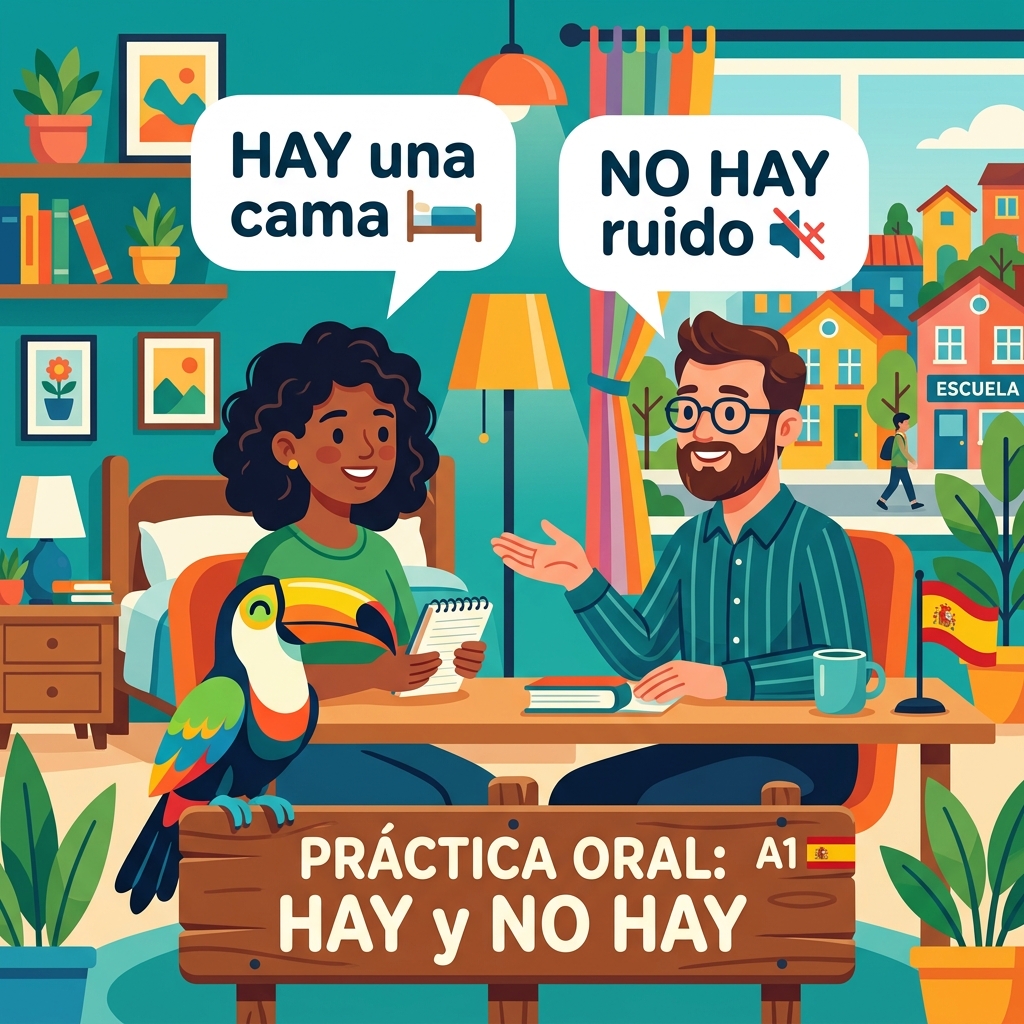
Nivel A1 · Práctica Oral con "Hay" y "No hay"
Level A1 · Speaking Practice with "Hay" & "No hay"
Spanish A1: Speaking Practice with "Hay" and "No hay"
Describe tu Cuarto, tu Barrio y Juega a Adivinar el Lugar
Describe your Room, your Neighborhood & Guess the Mystery Place
Habla en voz alta primero y luego escribe oraciones descriptivas completas usando "Hay" y "No hay".
Speak your sentences out loud first, then write down detailed descriptions using "Hay" and "No hay".
Teacher's Script & Explanation (To read to the student):
"Today we are going to learn how to describe places in Spanish using two very important words: 'Hay' and 'No hay'.
• 'Hay' translates to 'There is' or 'There are'. We use it to talk about things that exist in a place.
• 'No hay' translates to 'There is not' or 'There are not'.
The best part is that 'Hay' never changes! You can use it for one thing (Hay una cama) or many things (Hay dos camas). Today, you will use these words to describe your room, your neighborhood, and a mystery place!"
1
Actividad 1: Describe tu cuarto (Tu cuarto)
Activity 1 — Describe your room (Tu cuarto)
Instructions: Use the vocabulary bank below to describe your room using "hay" and "no hay". Don't just list items—try to add a small detail when you can (e.g., "Hay una lámpara pequeña en mi escritorio"). Speak your sentences out loud first, then write them down.
• una cama (bed)
• un armario (wardrobe)
• una lámpara (lamp)
• un escritorio (desk)
• una silla (chair)
• una ventana (window)
• un espejo (mirror)
• una alfombra (rug)
• un cargador (charger)
• una estantería (shelf)
• ropa (clothes)
• cuadros (paintings)
• libros (books)
• un despertador (alarm)
• una almohada (pillow)
• plantas (plants)
• mucho desorden (a mess)
• mucha luz (a lot of light)
Your task: Describe your room using at least 6 words from the bank above.
- 1.
- 2.
- 3.
- 4.
- 5.
- 6.
2
Actividad 2: Describe tu barrio (Tu barrio)
Activity 2 — Describe your neighborhood (Tu barrio)
Instructions: Now let's go outside! Describe your real neighborhood to your teacher using at least 5 words from this vocabulary bank. Tell your teacher what there is and what there is not (sentences with "no hay" count too!).
• un parque (park)
• una farmacia (pharmacy)
• un mercado (market)
• un café (café)
• una panadería (bakery)
• un hospital (hospital)
• una biblioteca (library)
• mucho tráfico (traffic)
• un semáforo (traffic light)
• muchos edificios (buildings)
• una cancha (sports court)
• un río (river)
• mucho ruido (noise)
• mucha gente (people)
• perros en la calle (street dogs)
• árboles (trees)
• una iglesia (church)
• tiendas (shops)
Your task: Write your 5 neighborhood descriptions here.
- 1.
- 2.
- 3.
- 4.
- 5.
3
Actividad 3: ¡Adivina el lugar! (Guess the place!)
Activity 3 — Guess the place!
How it works: Think of a mystery place (room, building, store, or outdoor place). Do not say the name of the place! Use hay and no hay to describe it, and your teacher will try to guess.
• Model Example:
Student: "Hay muchas camas. Hay médicos y enfermeras. No hay cocina. Hay mucho silencio..."
Teacher: "¿Qué lugar es? ¡Es un hospital!"
My mystery place — write your 6 clues here before you speak:
- 1.
- 2.
- 3.
- 4.
- 5.
- 6.
Extra challenge: Now it's your teacher's turn! Listen carefully to their description and guess their mystery place in Spanish by asking: "¿Es un/una ___________?"

 La Palabra Mágica: HAYGrammar Guide
 Adjetivos Esenciales A1Grammar Guide
 Spanish A1 Foundation WorkbookWorkbook